How Much Water Should You Drink a Day?
European and US health authorities put the adequate intake for healthy adults at 2 to 2.7 liters (about 68 to 91 fl oz) of water a day for women and 2.5 to 3.7 liters (about 85 to 125 fl oz) for men. These figures are total water, which includes the water in your food, so the part you need to drink is smaller. They are reference values for an ordinary day, not strict rules, and heat, exercise, illness, pregnancy and breastfeeding all raise them.
What the health authorities recommend
The European Food Safety Authority (EFSA) published its reference values for water in 2010. In the US, the National Academies of Sciences, Engineering, and Medicine (NASEM) announced theirs in 2004, in a report published in 2005. Both give an adequate intake for each group of people.
Adequate intakes at a glance
| Group | Europe (EFSA), total water | US (NASEM), total water | US (NASEM), from drinks |
|---|---|---|---|
| Women | 2.0 L (68 fl oz) | 2.7 L (91 fl oz) | about 2.2 L (74 fl oz) |
| Men | 2.5 L (85 fl oz) | 3.7 L (125 fl oz) | about 3.0 L (101 fl oz) |
| Pregnancy | 2.3 L (78 fl oz) | 3.0 L (101 fl oz) | about 2.3 L (78 fl oz) |
| Breastfeeding | 2.7 L (91 fl oz) | 3.8 L (128 fl oz) | about 3.1 L (105 fl oz) |
"Total water" means everything you take in: plain water, all other drinks, and the moisture in food. NASEM also estimated how much of that total came from drinks, shown in the last column. EFSA's values are total water only, and EFSA says they apply to "conditions of moderate environmental temperature and moderate physical activity levels". EFSA's adult values start at age 14 and NASEM's at 19, and both keep the same values for older adults.
What an adequate intake means
An adequate intake is not a minimum, and it is not a test you fail if you come in under it. NASEM describes it as an average daily level "based on observed or experimentally determined approximations", used when a firmer Recommended Dietary Allowance cannot be set. In other words, it reflects how much groups of healthy people typically take in, an amount assumed to be enough.
The report is direct about this: "the AI should not be interpreted as a specific requirement", and "wide ranges of intakes are compatible with normal hydration."
Total water vs what you drink
According to NASEM, water in food supplied about 20% of total water intake, and drinks supplied the other 80%, "including caffeinated beverages". How much comes from food on a given day depends on what you eat.
That is why NASEM's drinks-only figures are lower than its totals: about 2.2 liters (74 fl oz, roughly 9 cups) for women and 3.0 liters (101 fl oz, roughly 13 cups) for men. If you count only what you drink, these are the closer comparison.
Tea, coffee and milk count as well. The NHS says that "water, lower-fat milk and lower-sugar drinks, including tea and coffee, all count as part of your daily intake."
What raises your needs
The NHS lists several situations in which you may need to drink more:
- being pregnant or breastfeeding
- being in a hot environment
- being physically active for long periods
- being ill or recovering from illness
NASEM agrees that "higher intakes of total water will be required for those who are physically active or who are exposed to hot environments." It also notes that very active people who are continually exposed to hot weather often need 6 liters (about 203 fl oz) or more of total water a day. If you train hard or for a long time, read how much water to drink when exercising.
In pregnancy, EFSA adds 300 ml (about 10 fl oz) a day to the usual adequate intake for women. While breastfeeding, it adds about 700 ml (about 24 fl oz).
Children and teenagers
Children need less in absolute amounts, and their needs rise with age. EFSA's adequate intakes of total water are 1.3 liters (44 fl oz) at 2 to 3 years, 1.6 liters (54 fl oz) at 4 to 8 years, and 1.9 liters (64 fl oz) for girls and 2.1 liters (71 fl oz) for boys at 9 to 13 years. From 14, teenagers take the adult values. NASEM's figures are the same or somewhat higher: for example, 1.7 liters (57 fl oz) of total water at 4 to 8 years. For babies, follow your pediatrician's advice.
Why there is no single number
Needs differ with body size, diet, climate and activity, and from one day to the next. NASEM put it plainly: "We don't offer any rule of thumb based on how many glasses of water people should drink each day."
The UK's NHS offers a simple guide of 6 to 8 cups or glasses of fluid a day, without saying how big a cup or glass is. The popular eight-glasses rule has a story of its own, told in do you really need 8 glasses of water a day?
Let thirst help, with a few exceptions
For everyday life, NASEM says that "the vast majority of healthy people adequately meet their daily hydration needs by letting thirst be their guide." Drinks with meals play a big part: the report describes normal intake as "driven by the combination of thirst and the consumption of beverages at meals."
Thirst is a less reliable guide in some situations:
- Hot weather. The CDC advises you to drink more water than usual "and don't wait until you're thirsty".
- Older age. NASEM notes that "thirst and fluid intake are impaired in the elderly", so regular drinks matter even when you don't feel thirsty.
- Babies and young children. They depend on adults to offer them drinks.
The color of your pee is another simple check. The NHS says most people should aim to drink enough during the day so that their pee is "a clear pale yellow colour". If it is dark, or you feel unwell, read about the signs of dehydration and when to get help.
How to set your own daily goal
- Start with the adequate intake for your group from either authority.
- If you count only drinks, remember that food supplies part of the total; NASEM's drinks-only column is the closer match.
- Drink more on hot days, during long activity, when you are ill, and while pregnant or breastfeeding.
- Spread your drinks out. The NHS suggests you "drink regularly throughout the day".
- Pay attention to thirst and the color of your pee, and adjust.
If a doctor has told you to limit fluids (for example for heart failure or kidney disease), follow their limit rather than general advice.
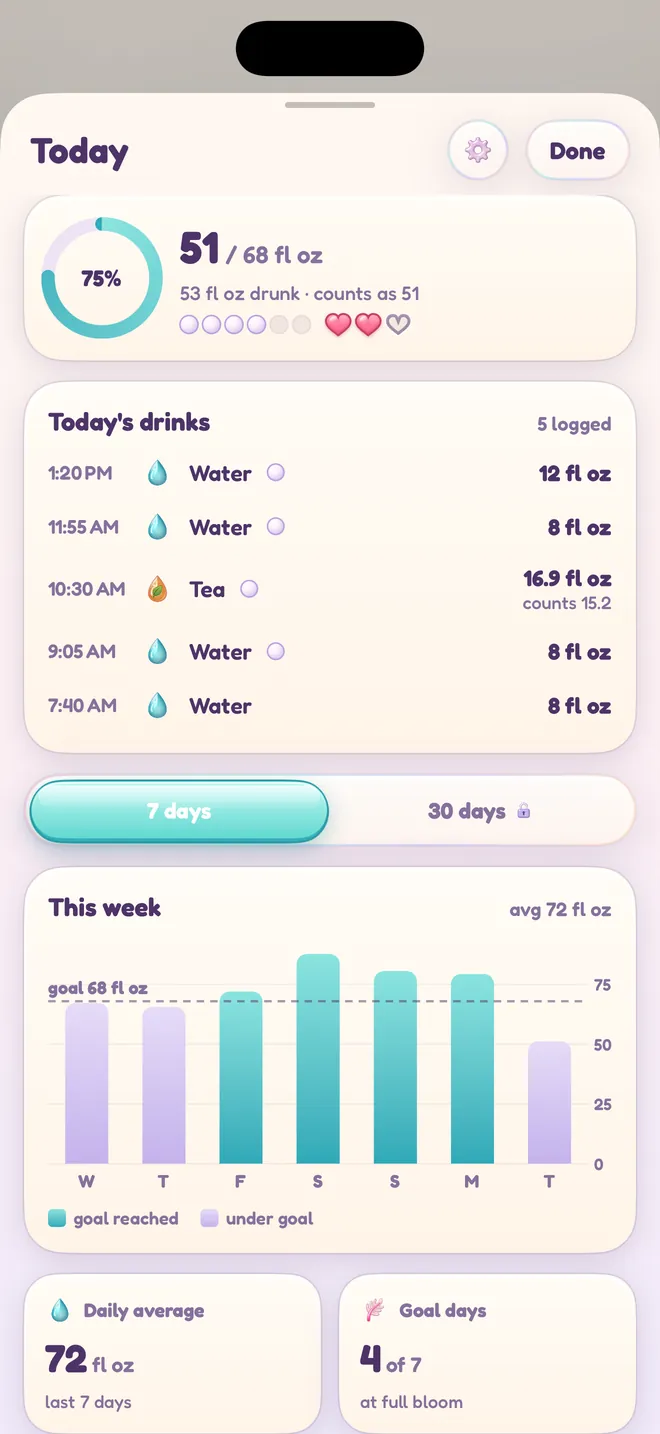
A tracker can do the adding up for you. In Hydrolotl, the suggested daily goal follows EFSA's guidance, and you can set your own instead, including a limit from your doctor. The Today screen lists each drink with its time and shows how close you are to your goal. For more ways to keep count, see how to track your water intake.
FAQ
How much water should I drink a day in ounces?
For women, the adequate intakes of total water are about 68 fl oz (EFSA) and 91 fl oz (NASEM); for men, about 85 and 125 fl oz. Because food supplies part of this, NASEM puts the drinks part at about 74 fl oz for women and 101 fl oz for men.
Does coffee count toward my daily water intake?
Yes. The NHS says tea and coffee count as part of your daily intake, and NASEM found that "caffeinated beverages appear to contribute to the daily total water intake." If you're pregnant, the NHS advises no more than 200 mg of caffeine a day.
Can you drink too much water?
It is rare for healthy people, and NASEM set no upper limit for water because healthy people in temperate climates normally regulate how much they drink. Acute water intoxication has been reported when people drank large amounts much faster than healthy kidneys can clear, which is at most about 0.7 to 1.0 liters (about 24 to 34 fl oz) an hour.
Do older adults need less water?
No. EFSA and NASEM give older adults the same adequate intakes as younger adults. Because thirst can weaken with age, it helps to drink regularly through the day rather than waiting to feel thirsty.
Sources
- European Food Safety Authority (2010). Scientific Opinion on Dietary Reference Values for water
- Institute of Medicine, National Academies (2005). Dietary Reference Intakes for Water, Potassium, Sodium, Chloride, and Sulfate: Summary
- Institute of Medicine, National Academies (2005). Dietary Reference Intakes for Water, Potassium, Sodium, Chloride, and Sulfate, chapter 4: Water
- National Academies (2004). Report Sets Dietary Intake Levels for Water, Salt, and Potassium to Maintain Health and Reduce Chronic Disease Risk
- NHS (accessed 2026). Water, drinks and your health
- CDC (2024). Protect Yourself From the Dangers of Extreme Heat
This article is general information, not medical advice. If you have a health condition or your doctor has given you a fluid limit, follow their advice.