How to Track Your Water Intake (and Keep It Simple)
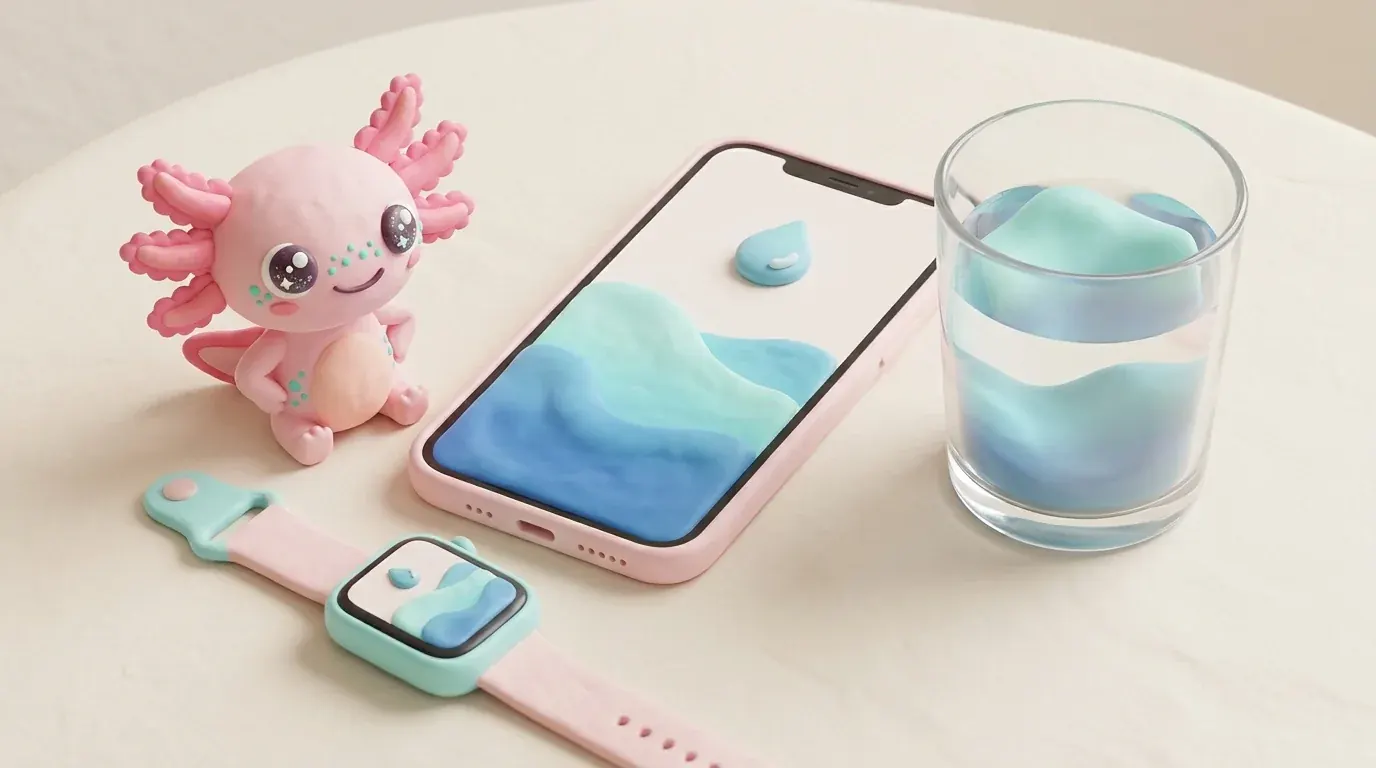
To track your water intake, pick one simple method, such as a bottle you know the size of, a tally of glasses, Apple Health, or an app on your iPhone or Apple Watch, and log each drink when you have it. Count all your drinks, not just plain water, and compare the total with a goal based on health authority guidance. Treat the number as a guide, not a test.
Why track at all?
If you are healthy and drink when you are thirsty, you may not need to track at all. The US National Academies note that "in general, normal hydration is maintained by thirst mechanisms and normal drinking behavior."
Tracking is useful when you want to build a habit, when you'd like to know how much you really drink on a busy day, or when a doctor has given you a fluid limit and you need to stay under it.
There is also some research behind keeping a record, though not about water. A 2009 analysis of 122 evaluations of healthy eating and physical activity programs, with almost 45,000 people in total, found that self-monitoring explained more of the differences between programs' results than any other technique it looked at. Programs that combined self-monitoring with at least one other self-regulation technique did better than the rest (effect sizes of 0.42 vs 0.26).
That analysis looked at diet and activity, not drinking water, so it doesn't prove that tracking water makes you drink more. What it does show is that self-monitoring is linked to success when people change eating and activity habits.
Ways to track your water
A bottle you know the size of
This is the lowest-tech option. If your bottle holds 750 ml (about 25 fl oz), counting refills is all the tracking you need: two and a half bottles make about 1.9 liters (63 fl oz). A strip of tape with a few marks on a plain bottle works too.
Counting glasses or cups
Measure your usual glass or mug once with a measuring cup, then keep a tally on paper or in a notes app. If your glass holds 250 ml (about 8.5 fl oz), eight glasses make 2 liters (about 68 fl oz). The catch is that mugs, cups and bottles vary a lot in size, so the tally is only as good as your estimate.
Apple Health
Apple Health can store water, measured by volume, and caffeine, measured by weight, as nutrition data. Apps you allow can write your drinks to it, and you can also add entries by hand: open the Health app, tap the Browse tab, tap a category and then a subcategory, tap Add Data, enter the date, time and amount, and tap Done.
Data you enter by hand gets top priority in Health by default. You can review which apps share data with Health under Profile, then Privacy, then Apps.
An app on your iPhone or Apple Watch
A water-tracking app turns each drink into a tap or two, adds up the day for you, and can remind you during the day. Logging from Apple Watch means you don't need your phone nearby. Whichever method you pick, the best one is the one you keep using.
What to log
Every drink, not just water. The NHS says that "water, lower-fat milk and lower-sugar drinks, including tea and coffee, all count as part of your daily intake." The US National Academies found that "caffeinated beverages appear to contribute to the daily total water intake." There's more in does coffee count as water intake?
Not usually the water in food. Food supplies about 19 to 20% of total water in the National Academies' data. Their figures for drinks alone already allow for that, so you can leave food out. If you're curious, see our table of foods with high water content.
Each drink when you have it. Logging as you go is easier and more accurate than trying to remember the whole day in the evening.
Choosing a daily goal
The European Food Safety Authority (EFSA) sets adequate intakes of 2.0 liters (about 68 fl oz) of total water a day for women and 2.5 liters (about 85 fl oz) for men, for moderate temperatures and moderate activity. The US National Academies estimate the drinks part of their higher totals at about 2.2 liters (74 fl oz) for women and 3.0 liters (101 fl oz) for men. These are reference values for healthy people, not strict rules. The full picture is in how much water should you drink a day.
Plan for more on some days. The NHS says you may need more fluid if you are pregnant or breastfeeding, in a hot environment, physically active for long periods, or ill or recovering from illness.
If a doctor has told you to limit fluids (for example for heart failure or kidney disease), follow their limit rather than general advice. In that case, tracking helps you stay under a number rather than reach one, and your care team can tell you what to count.
Tracking with Hydrolotl
Hydrolotl is the water tracker we make, for iPhone, iPad and Apple Watch. Instead of a bare counter, every drink you log fills a pet axolotl's tank, and reaching your daily goal fills it to the top. You can log water, tea, matcha, coffee, milk and sparkling water, and hold a glass, mug or bottle to change its size. Each drink counts by how much it adds to your water for the day: water counts in full, some drinks count a little less, and the Today screen shows both numbers.
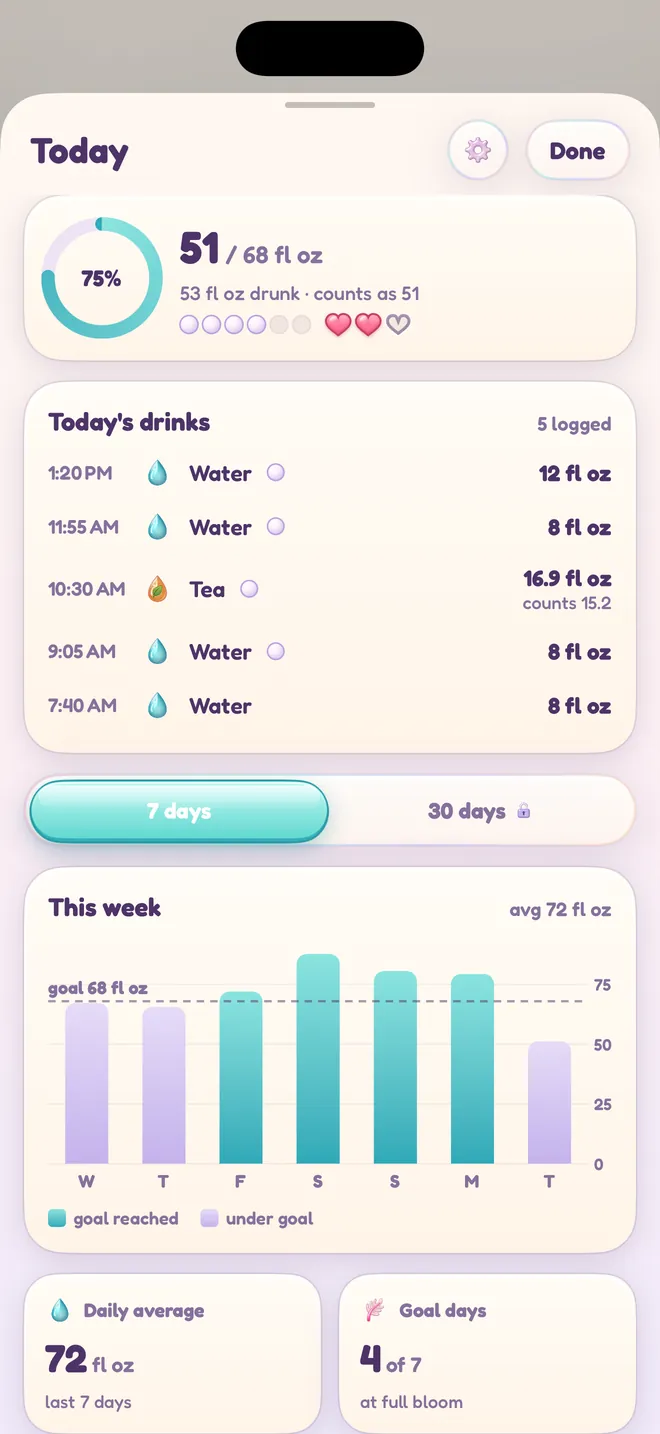
The Today screen lists your drinks with their times, a progress ring and the last 7 days. You can log from wherever is closest: Home Screen and Lock Screen widgets, a Live Activity in the Dynamic Island and on the Lock Screen, Siri and Shortcuts ("Log a glass in Hydrolotl"), Control Center, the Action Button, or Apple Watch, where you pour with the Digital Crown and log with Double Tap.
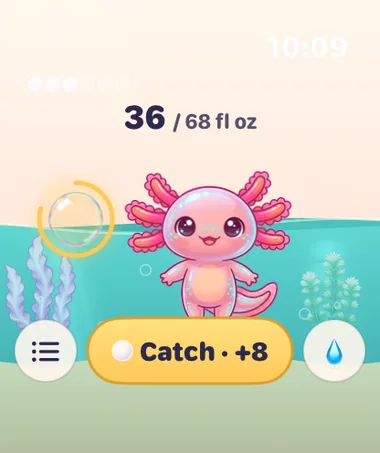
The suggested daily goal follows EFSA's guidance, and you can set your own, such as a fluid limit from your doctor. It is not a medical app. Reminders are local notifications with quiet hours. Apple Health is optional: the app writes water and caffeine and reads water. There is no account, no ads and no tracking, and the App Store privacy label says Data Not Collected. The app is free, and the optional Hydrolotl Plus adds 30-day trends, rare axolotl morphs and a monthly plant and décor pack.
Keep it light
A tracker should make drinking easier, not turn it into a test.
- Don't catch up all at once. If you are behind in the evening, let it go. Healthy kidneys can clear at most about 0.7 to 1.0 liters (about 24 to 34 fl oz) an hour, and acute water intoxication has been reported when people drank large amounts much faster than that.
- A missed day is just a missed day. Start again tomorrow; in our app, a missed day never resets your progress.
- Step back if it starts to feel like a chore. For healthy people in everyday conditions, thirst and normal drinking habits do most of the work.
FAQ
What is the easiest way to track water intake?
Use a bottle you know the size of and count refills, or log each drink in an app as you have it. The easiest method is the one you will actually keep doing.
Can Apple Watch track water intake?
You can log drinks on Apple Watch with a water-tracking app, which can save them to Apple Health as water. In Hydrolotl, for example, you pour with the Digital Crown and log with Double Tap.
Should I count coffee and tea in my water intake?
Yes. The NHS counts tea and coffee toward your daily intake, and the US National Academies found that caffeinated beverages appear to contribute to total water intake.
Do I need to track the water in food?
Usually not. Food supplies about a fifth of total water, and the drinks-only figures already allow for it. If you have a fluid limit, ask your care team whether to count soups and other watery foods.
Sources
- Michie et al. (2009). Effective techniques in healthy eating and physical activity interventions: a meta-regression
- Apple Developer (accessed 2026). HKQuantityTypeIdentifier: dietaryWater
- Apple Support (accessed 2026). Manage Health data on your iPhone, iPad, or Apple Watch
- NHS (accessed 2026). Water, drinks and your health
- Institute of Medicine, National Academies (2005). Dietary Reference Intakes for Water, Potassium, Sodium, Chloride, and Sulfate, chapter 4: Water
- European Food Safety Authority (2010). Scientific Opinion on Dietary Reference Values for water
This article is general information, not medical advice. If you have a health condition or your doctor has given you a fluid limit, follow their advice.