
Foods With High Water Content: A Table of Everyday Foods
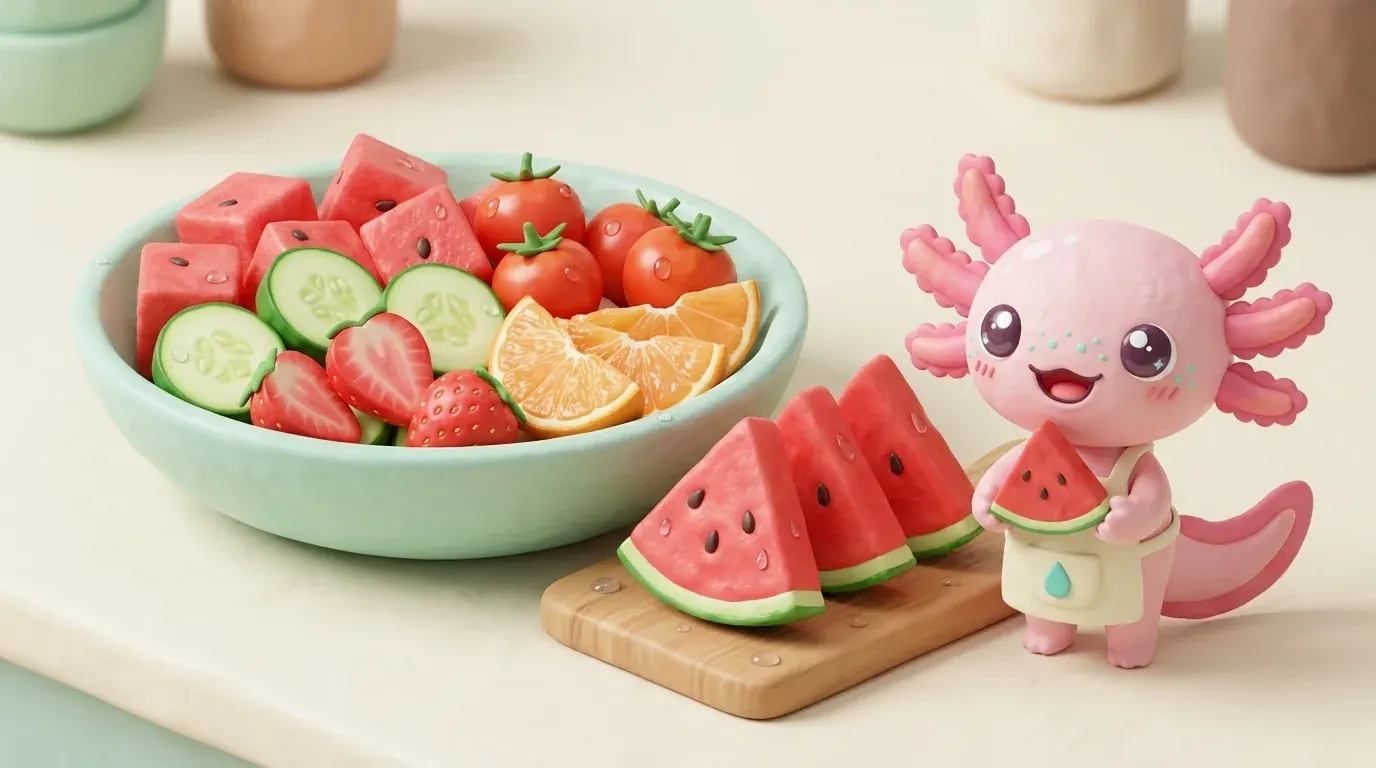
Many fruits and vegetables are more than 90% water. In USDA data, iceberg lettuce is about 96% water, celery and cucumber about 95%, and watermelon and strawberries about 91%; even cooked rice and pasta are more than 60% water. According to the US National Academies, food provides about a fifth of the water people take in, and it counts toward your daily total.
How much of your water comes from food
In the US National Academies' report on water, food provided about 19 to 20% of total water intake, and drinks the remaining 80% or so. The European Food Safety Authority (EFSA) also counts "food moisture" in its adequate intakes of total water: 2.0 liters (about 68 fl oz) a day for women and 2.5 liters (about 85 fl oz) for men.
So food is already built into the official numbers. The National Academies' estimates for drinks alone, about 2.2 liters (74 fl oz) for women and 3.0 liters (101 fl oz) for men, are lower than their total-water figures of 2.7 and 3.7 liters (91 and 125 fl oz) for exactly this reason. There is more on those figures in how much water should you drink a day.
The CDC puts it simply: "Foods, especially those with high water content such as many fruits and vegetables, can also add to fluid intake."
Water content of common foods
The table uses values from the USDA's FoodData Central database (SR Legacy dataset), rounded to the nearest whole percent. The percentage is by weight: grams of water in 100 grams of the edible part of the food. Foods are raw unless the table says otherwise.
| Food | Water content |
|---|---|
| Lettuce, iceberg | 96% |
| Celery | 95% |
| Radishes | 95% |
| Cucumber, with peel | 95% |
| Zucchini, with skin | 95% |
| Tomatoes, red, ripe | 95% |
| Green bell pepper | 94% |
| Watermelon | 91% |
| Spinach | 91% |
| Strawberries | 91% |
| Grapefruit | 91% |
| Cantaloupe | 90% |
| Broccoli | 89% |
| Whole milk (for comparison) | 88% |
| Plain yogurt, whole milk | 88% |
| Oranges | 87% |
| Apples, with skin | 86% |
| Plain yogurt, low fat | 85% |
| Bananas | 75% |
| White rice, long-grain, cooked | 68% |
| Pasta, cooked | 62% |
| White bread | 36% |
Fruit and vegetables lead the list
Salad vegetables come out on top. Iceberg lettuce, celery, radishes, cucumber, zucchini and tomatoes are all about 95% water, and green bell pepper is close behind at about 94%. Spinach and broccoli are around 90%.
Most of the fresh fruit in the table lands between about 86% (apples) and 91% (watermelon, strawberries and grapefruit). Bananas are lower, at about 75%.
To picture what that means: a gram of water is about a milliliter, so 100 g (3.5 oz) of cucumber holds about 95 ml (3.2 fl oz) of water. A 300 g (about 11 oz) bowl of watermelon holds about 275 ml (9 fl oz), a little more than a standard US cup of 237 ml (8 fl oz).
Dairy, cooked grains and soups
Plain yogurt is 85 to 88% water, almost as watery as whole milk at 88%.
Cooked grains hold more water than you might expect, because they soak it up as they cook. Cooked white rice is about 68% water and cooked pasta about 62%. For comparison, white bread is about 36%.
Soups, stews and porridge are made with water, broth or milk, so they carry plenty of it too, although the amount depends on the recipe. That matters most if your doctor has asked you to limit fluids (see below).
Does food count toward your daily water?
Yes. Both EFSA and the US National Academies count the water in food as part of your total water. That is also one reason a flat count of glasses can't fit everyone: it ignores what is on your plate, as we explain in do you really need 8 glasses of water a day?
In practice, you don't need to weigh your salad. It is simpler to keep track of your drinks and let food take care of the rest, since the drinks-only figures above already assume that food supplies part of your water.
Watery foods add to your drinks rather than replacing them. At about a fifth of total intake, food covers part of the day's water, and drinks cover the rest. If plain water is hard for you to enjoy, the CDC suggests you "add a wedge of lime or lemon to your water", and there are more ideas in how to drink more water.
If you have a fluid limit
If a doctor has told you to limit fluids (for example for heart failure or kidney disease), follow their limit rather than general advice, and ask whether watery foods count toward it.
For swelling caused by kidney disease, the NHS advises people to "reduce your daily salt and fluid intake, including fluids in food such as soups and yoghurts". For people on dialysis, the US National Institute of Diabetes and Digestive and Kidney Diseases (NIDDK) notes that most fruits and vegetables contain water, "such as melons, grapes, apples, oranges, tomatoes, lettuce, and celery", and that "your health care provider can help you figure out how much liquid is right for you."
FAQ
Which food has the highest water content?
Of the everyday foods in the table above, iceberg lettuce comes out on top at about 96% water. Celery, radishes, cucumber, zucchini and tomatoes follow closely at about 95%.
Does eating fruit count as drinking water?
It counts toward your total water, the measure EFSA and the US National Academies use. Food supplies only about a fifth of total water in the National Academies' data, so fruit adds to your drinks rather than replacing them.
How much water is in a cucumber?
Cucumber with its peel is about 95% water by weight, according to USDA data. That means 100 g (3.5 oz) of cucumber holds about 95 ml (3.2 fl oz) of water.
Do soups and yogurt count as fluid?
Yes, they add to your total water. The NHS specifically mentions soups and yogurts as fluids in food for people asked to cut back on fluid because of kidney disease, so if you have a fluid limit, ask your care team how to count them.
Sources
- USDA Agricultural Research Service (2018). FoodData Central, SR Legacy dataset
- Institute of Medicine, National Academies (2005). Dietary Reference Intakes for Water, Potassium, Sodium, Chloride, and Sulfate, chapter 4: Water
- European Food Safety Authority (2010). Scientific Opinion on Dietary Reference Values for water
- CDC (2026). About Water and Healthier Drinks
- NHS (accessed 2026). Chronic kidney disease: treatment
- NIDDK (accessed 2026). Eating & Nutrition for Hemodialysis
This article is general information, not medical advice. If you have a health condition or your doctor has given you a fluid limit, follow their advice.